10: 2001 SP Legendary Cuts Jackie Robinson Cut Auto

In the years of companies adding autographs to their sets, there was always a limit to the people that they could include. You needed to be alive to sign the card. In 2001, Upper Deck completely changed the concept of what could be put into packs in a few different ways. This was one of them. I put Jackie Robinson into this spot, but it could have been any number of legendary players in the set. What Upper Deck did was give collectors the ability to chase autographs they could never dream of having before this point.
Upper Deck dipped their toes into the concept of cut autos with a 2000 set dedicated to the Yankees, but this was the set that blew the doors off of the cut autograph industry. Cut autos came one per case in this high end set, which had a retail price of 180 dollars per box. This set gave you the ability for the first time to collect autographs from everyone from Babe Ruth and Satchel Paige to Branch Rickey and Roger Peckinpaugh. For the first time, the autographs industry became an infinite adventure.

Random Jackie Robinson Facts: While it would never be in question now, Jackie Robinson nearly didn’t make the Hall of Fame in his first year of eligibility. He ended up getting 77.5 percent of the votes, with 75% being the number you needed to get in. It should be noted that his first time being eligible was only 15 years after Robinson broke the color barrier, and had to fight the very same stereotypes while trying to make the Hall of Fame.

Fancy Boys Football Week 6 Mailbag

Fancy Boys Football Week 6 Mailbag

Fancy Boys founder Matt Drufke doesn’t know anything about football. Lucky for him, Brandon Andreasen and Jack Baker do.

Each week, Matt emails Brandon and Jack NFL questions, they then immediately go and make fun of his lack of knowledge in a secret group chat. They then go and answer the questions. Here are those answers.

Continue reading “Fancy Boys Football Week 6 Mailbag”

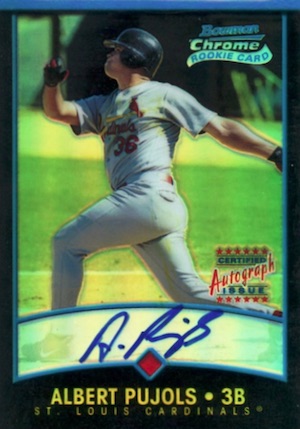
11: 2001 Bowman Chrome Albert Pujols

Now this is some iconic prospecting right here. It’s not to say that Albert Pujols came out of nowhere, but he was already in the middle of his 37 home run, 130 RBI rookie season when this card camae out. Needles to say, this card hit the ground running and never looked back. Bowman had always been known as the prospect set. It is where you sent if you were looking for cards from your favorite team of players that hadn’t made the majors yet.
In 1997, then released Bowman Chrome, with high end prospects on a glossy stock. Autographs were added as a chase element. In 2001, this became the card that everyone needed to have. It had a print run of 500, which was still considered a small run at that point. If Pujols had washed out after a couple seasons, this card would never be on the list. Instead, Pujols has had a Hall of Fame career, cementing this card’s legacy, and turning every Bowman Chrome release into a prospectors’ holiday. Now if only this damn Brandon Wood chrome auto would finally regain it’s value…

Random Albert Pujols Fact: For his career, Pujols has grounded into the most double plays of all time. In fact, as a still active player, Pujols is already 45 ahead of Cal Ripken, who is in second. The next closest active player is Miguel Cabrera, who is currently 77 GIDP’s behind.

12: 1992 Upper Deck Heroes Ted Williams Autograph

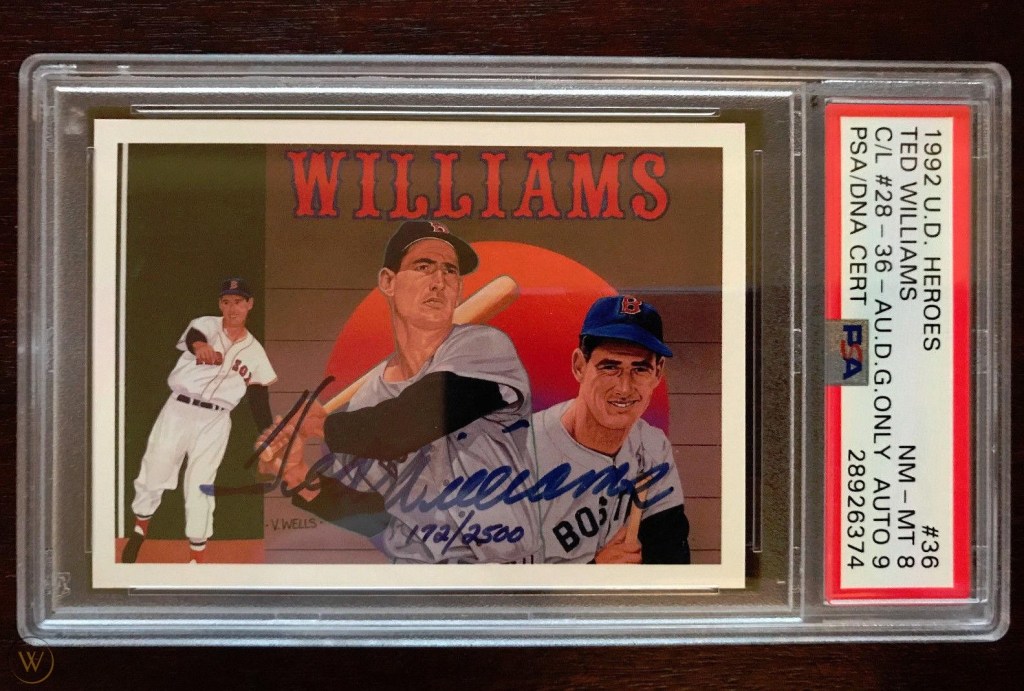
Just look at that card for a minute. It is such a perfect card. Everything about it is amazing. It also helps that Ted Williams has one of the cleanest autographs in baseball history. In 1991, Upper Deck decided to add a chase element to their sets. It was a similar card of Hank Aaron. The Williams just hits different, though. It’s a cleaner card looks wise and showed that Upper Deck was willing to promote themselves as the high end brand of the time. This card was also susceptible to forgeries, with people taking the unsigned version and hand numbering and signing them. Pre-internet, it was much harder to track who had what, and it led to a number of forgeries within the industry.

Random Ted Williams Fact: By the Baseball Reference WAR metric, Williams is the 14th best player of all time. This includes the fact that he missed three full seasons while enlisted in the military during World War II. Those three seasons were during his prime. In 1942, he had a 10.4 WAR. In 1946, his first year back, he had a 10.6 WAR. If he had batted that consistently in those three years, he would be in the discussion with Ty Cobb to be one of the 5-6 best players in Major League history.

13: 1955 Topps Sandy Koufax

Between 1962 and 1966, Sandy Koufax put up one of the greatest five years stretches in pitching history. He won three Cy Young awards and an MVP. He was also runner up for MVP twice. He was an MVP every one of these seasons. Then…his career was over. In 1965, he started experiencing extreme discomfort in his throwing elbow, and had to resort to using pain killers every day and even in the middle of starts. In 1966, he was told his arm simply couldn’t handle pitching anymore. He played the entire season, anyway. His final game was Game Two of the 1966 World Series. After the season he would retire and in the collecting world, that was it. There would be no new cards of Koufax made. Where as Roberto Clemente played 18 seasons, and Willie Mays and Hank Aaron each played over 20, Koufax had a 12 year career, with only five being remarkable in the way we tend to remember him.
The lack of longevity in his career compared to others of his era make all of his cards more collectible. His rookie, which of course has the same continuity and wear and tear issues as other cards of the day, is incredibly desirable and can be found in only very rare instances in a high grade.

Random Sandy Koufax Fact: In 1963, Sandy Koufax threw 11 complete game shut outs on the season. Only one person ever topped this mark, Bob Gibson in 1968 with 13.

14: 2011 Topps Update Mike Trout

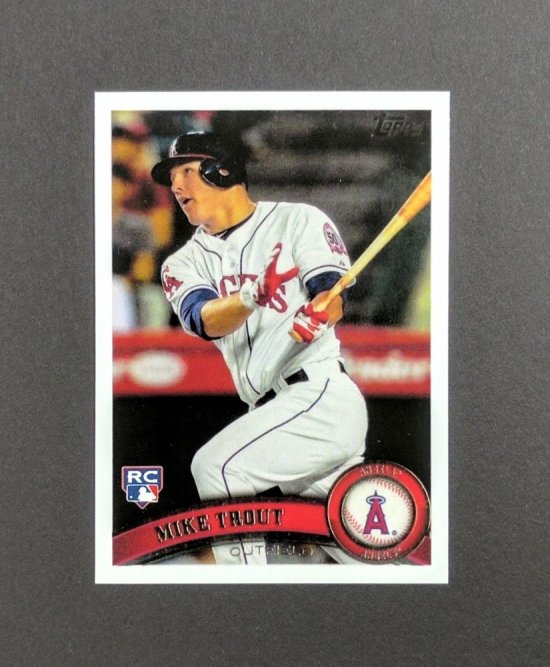
The Mike Trout Topps Update card is ten years younger than the next newest card on the entire list. There is a reason for this. Trout is the best player of his generation and if he continues on his current trajectory, he will be considered one of the greatest players in MLB history. It’s not big secret that players like this tend to have their rookie cards become very valuable. This card, which could have been purchased less than a decade ago for a dollar, is now worth many hundred times more than that.
This card is the catalyst for the Topps boom that has been seen recently with people prospecting the normally less popular update sets to get rookies of players like Vladimir Guerrero Jr, Pete Alonso, and Eloy Jimenez. Topps owes much of it’s current success to this card and the collecting habit it cultivated among a new generation of collectors that had become more focused on autographs and jersey cards in their collections.

Random Mike Trout Fact: Trout has been so good, that his Baseball Reference similarity score to this point in his career echoes some of the greatest players of all time, with the four most similar people in terms of production to this point are: Micky Mantle, Frank Robinson, Ken Griffey Jr, and Hank Aaron.

15: 1989 Fleer Billy Ripken

It took a lot to look at this objectively and not simply put this card in at number 3 or 4. Within the baseball card collecting community, this is one of, or possibly THE most infamous card in baseball history. For those not familiar with the history of this card, on the day that photographers were coming to shoot photos for their cards that season, someone played a trick on Ripken by writing “F*** Face” on the knob of his bat. Somehow, nobody noticed this until AFTER a lot of them had been put in packs and shipped out.
Fleer would end up sending out four different variations in later packs: the white scribble out, the white box out, the black scribble, and the black box. All have varying degrees of collectibilty, but there is no denying that this card has mainstream appeal far beyond most cards to make this list.

Random Billy Ripken fact: While the baseball draft sometimes seems very random, you can find value all over. Ripken was drafted in the 11th round of the 1982 draft, and ended up being gone of five players to play in the major leagues from that round. The fourth round of the same draft only produced six major leaguers.

16: 1990 Topps Frank Thomas No Name on Front

People of a certain age absolutely remember this card and the chase for it, along with the pitfalls of the growing counterfeit card industry. Topps was littered with continuity errors during this era (in their defense, so was Upper Deck) that still managed to slip into packs. While this could have been just another card in the junk wax era error database, this stands out because Frank Thomas was at the beginning of a Hall of Fame baseball career and would go down as on the Mt. Rushmore of best baseball players of the 1990’s.
1990 was not a particularly strong set beyond the second year card of Ken Griffey Jr. second year card. This card holds an almost mythic place among collectors of my generation because it was the first really rare card we were chasing through boxes of low end product.

Random Frank Thomas Fact: After leaving the White Sox after the 2005 season, Thomas would sign with the Oakland Athletics. Frank said that he had hard feelings towards the White Sox because owner Jerry Reinsdorf didn’t call him to let him know he would be released. In his first game against his former team, Thomas homered twice.

17: 1954 Topps Hank Aaron

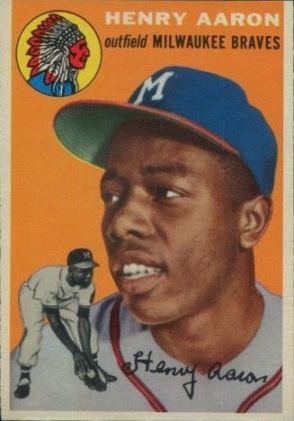
Remember what I said about 1955 Topps? Well the same goes for it’s predecessor, 1954 Topps. An absolutely beautiful design, and i’m personally a huge fan of the vertical look. Oh, and the card just happens to be of one of the greatest players ever, the guy who hit (depending on who you ask) the second most home runs in league history. Hank Aaron is one of the most iconic and enduring names in the history of baseball.
The 1954 set could win an “All Time Iconic Set” off, so Hammerin’ Hank is standing in for any number of great cards from this set.

Random Hank Aaron Fact: Over his career, Aaron didn’t make the All Star game in only two seasons, his rookie year, and his final year. In between, he would make 25 All Star Games.

18: 1955 Topps Roberto Clemente

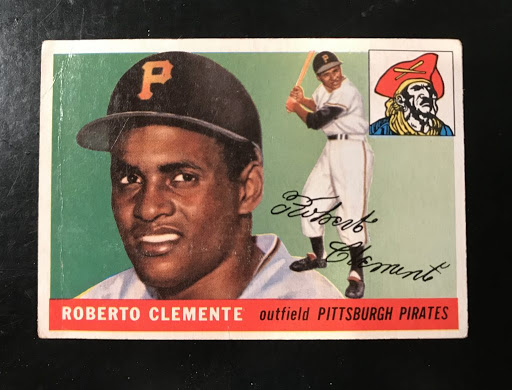
Full stop: I believe that 1955 Topps is one of the greatest baseball card designs in history. When I think of iconic, I think of this design, along with several others in the 1950’s and early 1960’s. it says a lot that Topps created an entire yearly set in Archives AND Heritage to recapture this aesthetic.
Beyond that, Clemente is one of the greatest baseball players of all time. The stories of his legend could fill a book. His life ended tragically. He never got the opportunity to have his life be fully celebrated in his post career.
Any number of his cards could fall under the “most iconic” banner, but I’ll go with his rookie card, which falls into the same issues as many cards of it’s era in terms of centering continunity, and many have simply faded over time.

Random Roberto Clemente Fact: Clemente led the National League in batting in 1964, 1965, and 1967. The only year among the four that he didn’t was 1966, when he won the NL MVP.