16: 1990 Topps Frank Thomas No Name on Front

People of a certain age absolutely remember this card and the chase for it, along with the pitfalls of the growing counterfeit card industry. Topps was littered with continuity errors during this era (in their defense, so was Upper Deck) that still managed to slip into packs. While this could have been just another card in the junk wax era error database, this stands out because Frank Thomas was at the beginning of a Hall of Fame baseball career and would go down as on the Mt. Rushmore of best baseball players of the 1990’s.
1990 was not a particularly strong set beyond the second year card of Ken Griffey Jr. second year card. This card holds an almost mythic place among collectors of my generation because it was the first really rare card we were chasing through boxes of low end product.

Random Frank Thomas Fact: After leaving the White Sox after the 2005 season, Thomas would sign with the Oakland Athletics. Frank said that he had hard feelings towards the White Sox because owner Jerry Reinsdorf didn’t call him to let him know he would be released. In his first game against his former team, Thomas homered twice.

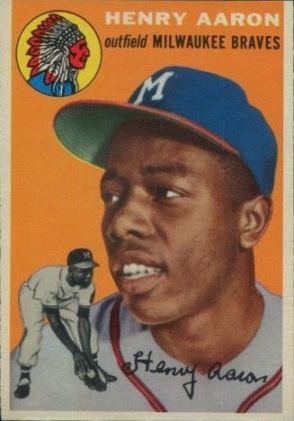
17: 1954 Topps Hank Aaron

Remember what I said about 1955 Topps? Well the same goes for it’s predecessor, 1954 Topps. An absolutely beautiful design, and i’m personally a huge fan of the vertical look. Oh, and the card just happens to be of one of the greatest players ever, the guy who hit (depending on who you ask) the second most home runs in league history. Hank Aaron is one of the most iconic and enduring names in the history of baseball.
The 1954 set could win an “All Time Iconic Set” off, so Hammerin’ Hank is standing in for any number of great cards from this set.

Random Hank Aaron Fact: Over his career, Aaron didn’t make the All Star game in only two seasons, his rookie year, and his final year. In between, he would make 25 All Star Games.

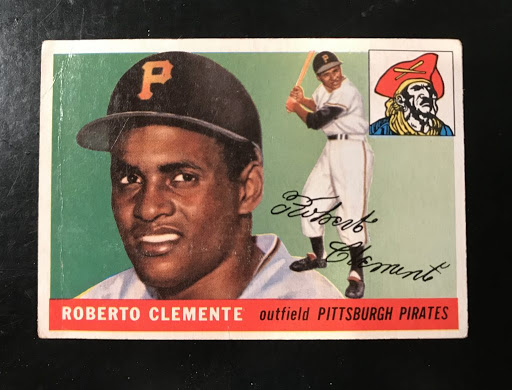
18: 1955 Topps Roberto Clemente

Full stop: I believe that 1955 Topps is one of the greatest baseball card designs in history. When I think of iconic, I think of this design, along with several others in the 1950’s and early 1960’s. it says a lot that Topps created an entire yearly set in Archives AND Heritage to recapture this aesthetic.
Beyond that, Clemente is one of the greatest baseball players of all time. The stories of his legend could fill a book. His life ended tragically. He never got the opportunity to have his life be fully celebrated in his post career.
Any number of his cards could fall under the “most iconic” banner, but I’ll go with his rookie card, which falls into the same issues as many cards of it’s era in terms of centering continunity, and many have simply faded over time.

Random Roberto Clemente Fact: Clemente led the National League in batting in 1964, 1965, and 1967. The only year among the four that he didn’t was 1966, when he won the NL MVP.

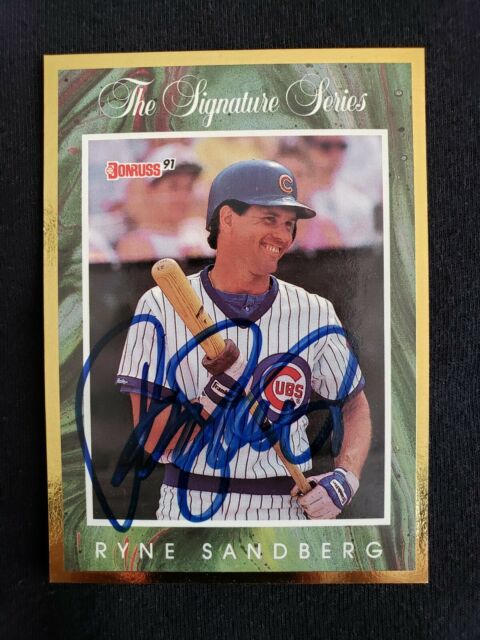
19: 1991 Donruss Elite Signature Series Ryne Sandberg

1991 was definitely still the junk wax era, and the junk wax had expanded with Topps, Donruss, Fleer, and Upper Deck all releasing products that year. That, coupled with a number of busts in recent years for prospectors (Brien Taylor and Todd Van Poppel come to mind) left a lot to be desired in the industry. Donruss had a set for a number of years in their product called Diamond Kings, with artistic renderings of star players on the card. In 1991 they introduced Elite Series, a chase insert set with a high gloss finish and gold edges. Cards were mostly numbered to 10k cards, which seems silly now, but was considered an insane short print then.
Out of that came a single card shorter print card. It was an autographed card of Ryne Sandberg. The concept was almost unprecedented, adding such a chase element to baseball cards. After that, inserts and autographs started to become synonymous with pack opening.

Random Ryne Sandberg Fact: Sandberg was drafted in the 20th round of the 1978 MLB draft. From everyone drafted in that round that year, they had a total of 8390 MLB at bats. Sandberg was responsible for 8385 of them.

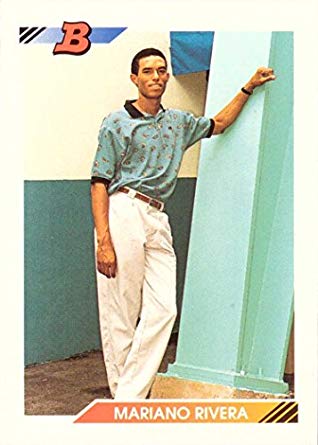
20: 1992 Bowman Mariano Rivera

Some cards don’t have to be super valuable to be iconic (a mint 9 can be purchased on eBay for under 125 dollars). Sometimes the image on the card combined with the player in the image completely makes the card. Look at how great this picture is. Why does it appear Rivera is pushing over that beam? Who dressed Mariano? The outfit is glorious, from the white chinos to the tucked in collared short sleeve shirt. He appears to be 18 years old in this picture.
A failed starter, Mariano Rivera would move to the bullpen and after a year setting up for John Wetteland, he would step in to become the most iconic closer in the history of baseball. This card acts as a time capsule to one of the all time greats.

Random Mariano Rivera Fact: Rivera is the first person to be inducted unanimously into the MLB Hall of Fame. Voted on by baseball writers, every person before him were left off at least one ballot.

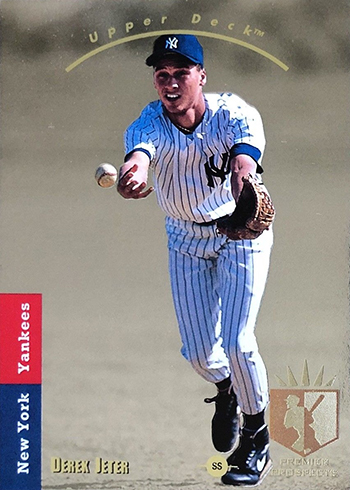
21: 1993 SP Premier Prospects Derek Jeter

How rare is it to find this card in a high grade? A gem mint 10 sold in January for 180,000 dollars. Upper Deck was doing it’s part in the early 90’s to differentiate their flagship product with a higher end product. That product was SP. The set leaned heavily on die cuts and foil on the front of the card. The issue with using foil is that it creates an extremely condition sensitive card, with any blemish being very noticeable. This made the cards susceptible to surface scratches, corner dings, and chipping.
Just how rare is it to find this card in absolute mint condition? Of the 14k graded by PSA, only 22 have graded out at gem mint 10.

Random Derek Jeter Fact: The Yankees qualified for the playoffs in 17 of the 20 seasons that Jeter played for the team. He had a career .309 batting average in the postseason.

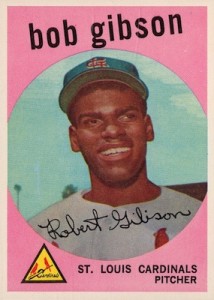
22: 1959 Topps Bob Gibson

If you need reference for how good Bob Gibson was, they had to change the rules and lower the mound because Bob Gibson was so good, nobody could hit him. Gibson is one of the top pitchers in the history of the modern era and his rookie card came at a time of large scale discrepancies with card quality.
For those not aware, baseball cards aren’t printed individually at their size as found in packs. They are printed with around 100 other cards on a large printing sheet, then cut down using industrial equipment. Quality control wasn’t as big of an issue then, and it led to many off center cuts, affecting the overall look of the card. That, combined with the card being 61 years old means that very few of these cards can be found in a high grade, making centered cards with good corners incredibly desirable.

Random Bob Gibson fact: Gibson won the Cy Young in 1968 with a 1.12 ERA. That is the lowest ERA all time for a starting pitcher who won the award. Only Rollie Fingers had a lower ERA, with 1.08 in 1981 coming out of the bullpen for the Milwaukee Brewers.

23: 2007 Topps Derek Jeter

If you were just scanning through packs of 2007 Topps, looking for hits, you might have missed this card initially. There wasn’t anything remarkable about this year’s Jeter card. It was his 15th in the base set history. But if you really key in on the card, something, or more accurate, someone stands out. That is George W. Bush in the crowd of the set. This would be the second time a sitting president named Bush was on a Topps card. In 1990, Topps gave president George HW Bush a small amount of cards featuring an image of the elder Bush during his playing days at Yale.
You could be forgiven if you thought that was the only photoshop in the card. That is Mickey Mantle is in the dugout. Topps was starting to experiment with the idea of doing short print and super short print variations of base cards. This was one of the most interesting early cards and it immediately sky rocketed in value. Without knowing the exact print run, the card quickly gained value, selling for hundreds of dollars when they were first released. The card has come back down to a reasonable level but is a key turning point in sports card companies adding endless variations to sets.

Random Derek Jeter Fact: Jeter made the All Star team 14 times over his career. He was the sixth pick in the 1992 Draft. The five players drafted ahead of him combined for 2 All Star Game apperances.

24: 1984 Topps Traded Dwight Gooden

For his career, Dwight Gooden was a good pitcher, amassing nearly 200 career wins and four all star game appearances, a Cy Young award, and the 1984 Rookie of the Year award. How he came into the baseball conscious though is what makes this card so iconic. That it wasn’t a card that was as readily available made it more desirable. Released in the 1984 Topps Traded set, the card didn’t have as wide of a print run as it’s base set doppelganger that would be released in 1985. When Gooden came in and won 17 games, striking out 276 batters that season, it sent collectors looking for any item they could find of the phenom Mets pitcher. Topps added him to their late season subset, and this card became the hottest item on the market.
While his career would ultimately fall short of what people believed it could be after his first three seasons in the league, the chase for this card was one of the first prospector chases of the 80’s that would come to define a large community of sports card collecting to this day.

Random Dwight Gooden Fact: In 1985, Gooden had 16 complete games. Combined, the top four National League complete game leaders in 2018 and 2019 pitched a total of 14 complete games.

25: 1982 Topps Cal Ripken RC

Cal Ripken’s credentials in Major League Baseball history are among the most well regarded of all time. His rookie card is desirable, while still being easily findable. His rookie came out in the early days of the of the junk wax era, a generation of baseball cards that were so mass produced that their value will forever be suppressed due to how many are in existence. In terms of all time greats, this is a great collecting entrance point. The upside of the junk wax era is that it allows you to be picky about the condition of the card you are looking for. In raw condition, you can still find this card for good value, and even graded out at an 8 or higher won’t break the bank.

Random Cal Ripken Fact: Ripken has the fourth most All Star Game appearances in MLB history, trailing only Hank Aaron, Willie Mays, and Stan Musial.