1: T206 Honus Wagner

As if there could be any other card in this spot. The greatest sports card in history with the biggest myths and mysteries surrounding it. The card is worth millions if it’s in even passable condition. It is the card sports collectors dream about getting their hands on. Simply put, it is the most important, most iconic card in the history of collecting. We may never know exactly how many of this card exist, but we do know the number is small and isn’t likely to rise dramatically.
If you aren’t overly familiar with this card: this is the 1909-1911 T206 Honus Wagner card. It was released in packs of various brands of cigarettes, as most cards were in the day. Depending on the story you believe, either Wagner was very anti-smoking and demanded his card be pulled, or he wanted a cut of the royalties for using his image, and the card was pulled. Either way, it exists in much lower numbers than any other card in the set, and it’s a joke to even say this set is condition sensitive. The set is 110 years old. If a card from this set is found in one piece, it’s considered a success.
This card is the most iconic because it has the most crossover appeal. It gains headlines on television over it’s value whenever it goes to auction. It draws out the most high end collectors to try to get their hands on it. It exists as an almost mythological example of what collecting can be. It is, without a doubt, the most valuable and iconic card in baseball history.

Random Honus Wagner Fact: He is, and will most likely forever be, the only person in the history of Major League Baseball named Honus.
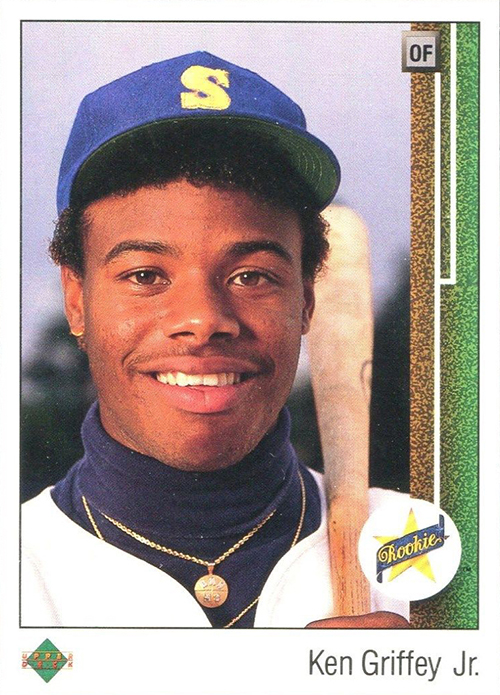
2: 1989 Upper Deck Ken Griffey Jr.

If you collect baseball cards, you know the credentials of this already. It sparked a hobby boom and was the reason card companies started doing higher end products. 1989 Upper Deck alone changed the collecting game, with it’s clean, minimalist look and high gloss stock. Griffey was well on his way to paving the path to being the best player of his generation. This card sparked such a frenzy that Upper Deck made the (ill fated) decision to continue producing new 1989 cards well after the print run should have dried up. They kept flooding the market with this card, and even then it didn’t seem to be enough. They reportedly continued making the 89 set well into 1990. This is what keeps this card at a lower price point than most on the list. Upper Deck released a card in the junk wax era, and then somehow over produced it.
This card might be single handedly responsible for modern collecting as we know it today.

Random Ken Griffey Jr. Fact: Many people blame going to Ohio for Griffey falling off production wise, and some numbers bare that out. He made ten consecutive All Star games before leaving for Cincinnati, and only made three in eight and a half seasons for the Reds. The truth is though, part of what made Griffey great was how hard he played on offense and defense, and his body started to catch up with him around that point. He only played 140 games in a season twice for the Reds, and during a three year stretch, played 70, 53, and 83 games for them.

3: 1968 Topps Nolan Ryan/Jerry Koosman

Runner up to Johnny Bench in 1968, Jerry Koosman carved out a long and successful career as a major league pitcher. Across four teams in 19 seasons, he would end up with 222 wins. In 1976, Jerry was the runner up for the Cy Young award, and followed that up the next year by losing 20 games, tops in the league. But he isn’t why this card is here.
Nolan Ryan is one of the most endearing old school players in the history of the game. His career spanned nearly three decades and you can use his career to get to any era of baseball in less than six degrees of separation. he beat up Robin Ventura and threw seven no hitters. He pitched until he literally couldn’t throw anymore. This card is iconic because it came at a time when Topps was the only game in town. If you collected cards, you collected Topps or you collected nothing. This was a prospector card before people knew what that was. It’s a must have for any serious collection and continues to endure as one of the most iconic cards in the history of baseball.

Random Jerry Koosman Fact: Koosman would finish with 20 victories twice in his career. He was top six in terms of voting for the Cy Young each year. He didn’t make the All Star team in either season.

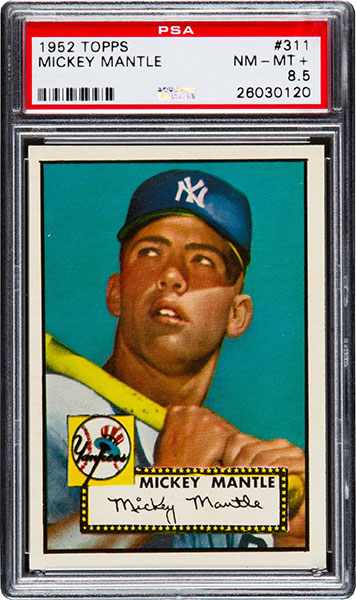
4: 1952 Topps Mickey Mantle

Considered by many to be the G.O.A.T. of baseball cards, the 52 Mantle is one of the most valuable cards of all time. Finding one in good condition is like writing yourself a check for a new house. Mantle was a beloved player in the biggest market, pushing sales up even further. The card is known among sports card circles as one of the holy grails of collecting. Only two cards have ever crossed the million dollar threshold. The card shown above is one of them. Borne in an era when condition wasn’t taken into as big of consideration, and before Topps had a strong foot hold in the collecting community, finding this card requires more luck than most will ever understand.

Random Mickey Mantle Fact: On three occasions, Mantle came in second place for the AL MVP award. In two of those cases, he lost to the same person, teammate and fellow outfielder Roger Maris.

5: 1997 Upper Deck Ken Griffey Jr Game Used Jersey

If you want to quibble about it, Upper Deck tried this with hockey first. But this is an iconic baseball card ranking, and this card changed the future of all baseball cards. Upper Deck were the first to decide they could put a piece of game worn jersey onto a baseball card and build hype around it. Griffey was the best player in the world at this point. He was the player that everyone else based their games off of. Ken Griffey Jr. was one of the best players of his generation and his willingness to be apart of this series would cause a seismic shift in the baseball card industry.
Before this point, the chase cards were really just cards. This was the first card to make baseball collectors rethink their entire collecting philosophy.

Random Ken Griffey Jr Fact: Griffey would end up being the most famous player from Archbishop Moeller High School, but he was far from the only person to play MLB baseball. 14 players would see action in the majors. He wouldn’t even be the first player from this high school to make the Hall of Fame. Barry Larkin played at the same high school and made the HOF six years before Griffey.

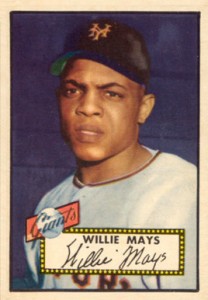
6: 1952 Topps Willie Mays

I believe Willie Mays is the greatest player of all time. He was an epic hitter while playing one of the most difficult positions in baseballl. He covered multiple generations. He is the player Mike Trout ascends to be. If he was from this generation, pundits would breathlessly speculate which team he would leave for as soon as he hit free agency. He would be the transcendent star that all other players were judged by.
The card. The man. The legacy. Willie Mays was a generational player, someone whose game is so rare that you have to squint just to judge anyone else against his legacy. His rookie card rightfully deserves a level of respect and precedent that most cards will never have.

Random Willie Mays Fact: In two total seasons for the Mets, Mays hit 14 home runs. In his 20 years as a Giant, he only hit fewer than 14 home runs twice, and one of those seasons was 1952, where he only played 34 games.

7: 1999 UD Piece of History Babe Ruth Game Used Bat

If there was a list for “most controversial cards of all time” then this might be at the top. While legendary players with bat and jersey cards are commonplace now, this was considered sacrilege back in the day. There was an outcry in the industry when this card came out, after Upper Deck purchased a Babe Ruth bat at auction, and started slicing it up to put on cards.
There are two schools of thoughts on this card. The first is that by cutting up the pieces of history, it gives much more people the ability to own a relic they would never have the ability to do otherwise, and baseball is a sport of the people, and this allows the people to have their piece of baseball history.
The other school of thought is that these are rare pieces of history that there will never be more of. You can’t replace a Babe Ruth bat. You can’t replace a Babe Ruth jersey. Once they are gone, they are lost to history. They shouldn’t be broken down because they can never be enjoyed for what they are ever again.
Either way, this card is one of the linchpins of this debate, which carries on to this day.

Random Babe Ruth Fact: By Baseball Reference WAR, Ruth is considered one of the two greatest baseball players of all time. Yet, when he was up for election in the inagurual baseball Hall of Fame class, 11 people didn’t vote for him!

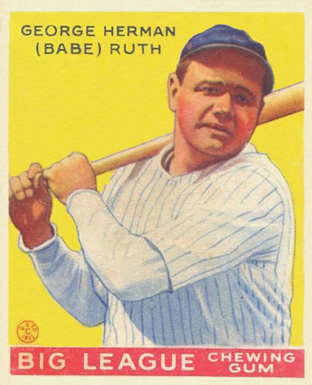
8: 1933 Goudey Babe Ruth

1933 Goudey is influential and iconic because it was the moment that baseball card collecting went from an adult activity to a childrens activity. Before this point, baseball cards were released with cigarettes. Goudey Gum released the 240 card set in packs that came with a piece of their gum. The cards didn’t look cheap like so many other doppelgangers of the era.
Babe Ruth is the most iconic player of the era and was the choice for this spot, but some hardcore collectors would correctly point out that it might not be the most important card in it’s own set. When the set was released, there was no card # 106 in the set. People who sent letters in the mail to Goudey ended up receiving a Nap Lajoie card as the final card of the set. Because of the way it was distributed, this card exists in far lower numbers and is considered one of the holy grails of the collecting industry.

Random Babe Ruth Fact: While many baseball fans might be aware of this, average fans probably don’t know that Babe Ruth hit his called shot home run at Wrigley Field off of Charlie Root during the 1932 World Series. Debate remains to this day whether he was actually calling his shot, pointing at the pitcher, or at the Cubs bench players, who had spent the entirety of the World Series heckling him.

9: 1993 Topps Finest Refractor Nolan Ryan

Topps Finest might be the most important set to be released of the 1990’s. Topps was trying to compete with Fleer Flair and Upper Deck SP in the high end baseball card market. This release was unlike anything that had been seen on the market before. The colors were bright and vibrant. They were printed on a high end gloss stock.
The refractors were a parallel set that came one per box. They immediately grew in popularity based on their rarity. While print runs weren’t officially released initially, it is believed that there were only 241 of each refractor made. Much like the last entry, I could have chosen a number of players to be this entry, but Ryan is one of the most consistently high sellers in the secondary market to this day.
This set ended up paving the way for the parallel sets that are so recognizable with today’s baseball product.

Random Nolan Ryan Fact: Over his 27 year career, Ryan averaged 246 strikeouts per season. In 2019, only six pitchers were able to throw for more strikeouts.

10: 2001 SP Legendary Cuts Jackie Robinson Cut Auto

In the years of companies adding autographs to their sets, there was always a limit to the people that they could include. You needed to be alive to sign the card. In 2001, Upper Deck completely changed the concept of what could be put into packs in a few different ways. This was one of them. I put Jackie Robinson into this spot, but it could have been any number of legendary players in the set. What Upper Deck did was give collectors the ability to chase autographs they could never dream of having before this point.
Upper Deck dipped their toes into the concept of cut autos with a 2000 set dedicated to the Yankees, but this was the set that blew the doors off of the cut autograph industry. Cut autos came one per case in this high end set, which had a retail price of 180 dollars per box. This set gave you the ability for the first time to collect autographs from everyone from Babe Ruth and Satchel Paige to Branch Rickey and Roger Peckinpaugh. For the first time, the autographs industry became an infinite adventure.

Random Jackie Robinson Facts: While it would never be in question now, Jackie Robinson nearly didn’t make the Hall of Fame in his first year of eligibility. He ended up getting 77.5 percent of the votes, with 75% being the number you needed to get in. It should be noted that his first time being eligible was only 15 years after Robinson broke the color barrier, and had to fight the very same stereotypes while trying to make the Hall of Fame.